
“Everybody needs beauty as well as bread, places to play in and pray in, where Nature may heal and cheer and give strength to the body and soul alike.”
-John Muir
When one thinks of Yellowstone, the first thing that crosses the mind is the oddities of the geothermal world… the geysers… the hot springs. But Yellowstone offers so much more. It holds a large abundance of biodiversity, it provides us a rich Native history, and it gives us with other geological wonders to marvel at.
Don’t get me wrong, Yellowstone’s geothermal features are definitely something you do not want to miss. I already wrote a blog post on the amazing sights you can see, and what are our best recommendations for seeing geysers, hot springs, mud pots, and fumaroles. You can find that blog post here.
But Yellowstone’s massive size also harbors some other sights to see, places sometimes overlooked when one first mentions Yellowstone. It is these features that I hope to shed light on in today’s blog post.
Before I go into what other sights you can see, first I want to talk about Yellowstone’s size. The park is massive. Yellowstone encompasses over 2 million acres of land. The park is larger than Delaware and Rhode Island combined. There are miles of backcountry trails where a devoted hiker and backpacker can access parts of the park you can’t see from the road.
There is one major road that runs through the park. The Yellowstone Grand Loop road runs for 142 miles. Couple that with 40 mph speed limits, and you can get a feel for how long it would take to travel the loop, and that is without stopping. The loop road is laid out like a giant figure eight, with one road cutting across the center of the park, connecting Norris Geyser Basin with Canyon Village.
There are five entrances into Yellowstone. Dan and I have gone through all but one of them. The southern entrance connects with Grand Teton National Park, in Wyoming. The western entrance connects to Cody, Wyoming, and between the town and the entrance, lies the Shoshone National Forest. The northeastern entrance is the only one we have not driven through. It winds through Lamar Valley and connects the park with Cooke City, Montana. The northwestern entrance connects Mammoth Hot Springs with the town of Gardiner, Montana. Both the northeast and northwest entrances were closed this summer after monumental flooding in that part of the park during the spring of 2022. The final entrance connects the western part of the park to West Yellowstone, Montana. It is this entrance through which we accessed the park during this visit.
Each of these entrances sit several miles off the grand loop road, with some taking longer to access the loop than others. When we entered from West Yellowstone, we had a 14 mile drive before we hit the Grand Loop Road . Keep this in mind as you think about planning a trip to the park.
There are so many different sights to see when you are inside the park. We’ve listed a few of our favorites. Some are easier to access than others, some require a little hiking, but they are all well worth it if you have the time and energy to see them!
Grand Canyon of the Yellowstone
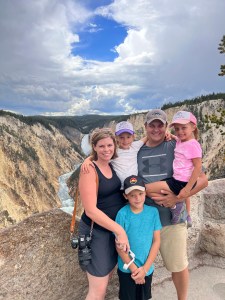
Imagine a park with a waterfall so grand, a river carving a wide and deep canyon, that it carries the name of another of the most iconic sights in the United States. The Grand Canyon of the Yellowstone is located in the western part of the park, and it is an amazing sight to see.
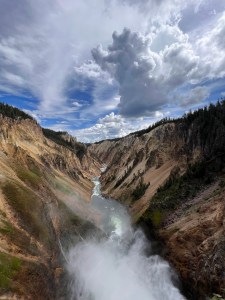
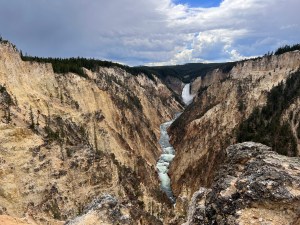
The Grand Canyon of the Yellowstone is carved by the Yellowstone River. There are two large waterfalls cascading down, the Upper Falls and the Lower Falls. The Lower Falls are taller than the Upper Falls, but both are well worth seeing. The river carved a massive canyon, hugged on both sides by yellowed rock, tinted that color from the sulphuric deposits under the Earth. The upper falls cascades down a 109 foot drop, but that is small compared to the 308 foot drop of the lower falls. Parts of the canyon are tinted a reddish hue, essentially rusting from the iron ore within the rock. Coupled together, the canyon and falls create a majestic view only worthy of our first national park.
All of these sights can be accessed starting at Canyon Village. The first drive I would take is the North Rim Drive. This one way road skirts the nothern rim of the canyon. From this drive, one of the best short hikes that you can take is the Brink of the Lower Falls. This short 0.7 mile hike is steep. You walk down a series of switchbacks until you are literally standing right at the brink of the Lower Yellowstone Falls. Get right to the corner of the platform and you can get stunning views of the falls as they cascade over the edge, plunging 308 feet into the canyon. Just remember that you have to hike back up the switchbacks. There are plenty of benches or short walls to stop and rest on your way back up if needed though.


After doing the Brink of the Lower Falls hike, continue along the North Rim Drive. There will be turn offs where you can walk down to view the falls. There is also a trail where you can hike along the northern rim of the canyon if you are interested in taking that hike. We opted to just drive the rim and spend our time hiking to some other sights in the park. I would definitely make a stop at Inspiration Point as you will get a nice view of the falls along the northern rim.
After completing the North Rim Drive, I recommend backing around to now drive the South Rim Drive. This drive is a two-way road and has multiple stops along the southern rim of the canyon. One of the first pull offs that I recommend is the Upper Falls Viewpoints. This access point has been redone in recent years and is a pretty awesome stop. The Upper Falls are not as tall as the Lower Falls, but you can still view them at their brink. The water color is beautiful and the viewpoint is very close to the parking lot.

The last stop I would make on the South Rim Drive is at Artist Point. In my opinion, this point gives the best view of the Lower Falls and the entire canyon. If you could only stop at one of these picture points, this is my top recommendation. The views of the canyon are breathtaking, especially with the falls in the distance.
More Waterfalls
Yellowstone is home to many waterfalls. The most spectacular are definitely the falls of the Yellowstone, but there are others that are worth mentioning if you have time to stop at additional viewpoints.
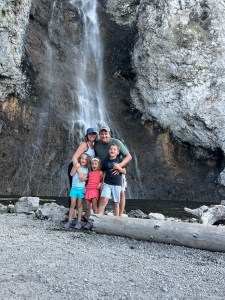
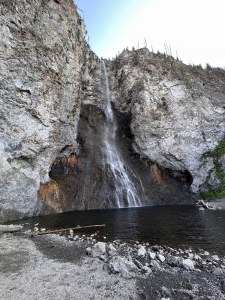
Fairy Falls is a 5-mile round trip hike. The trailhead can be accessed close to the Grand Prismatic Spring geyser basin. If you read my previous post, this is the same trail that you use to access the Grand Prismatic overlook. If you have the time, I definitely recommend you keep on going. While the trail is five miles long, it is an easy hike. The trail is wide and flat for the majority of the hike. At the end of the hike you will see gorgeous Fairy Falls. The falls drop 200 feet and you get to stand at the bottom of it all. While the falls are most impressive in the spring, it is still a worthwhile stop later in the summer.
Tower Falls is an easy stop off the Grand Loop road with a very short walking path for an overlook of the falls. You can access it at the parking lot between Canyon Village and Roosevelt. This is only an overlook however, and there is no trail that will take you for a closer look of the falls.
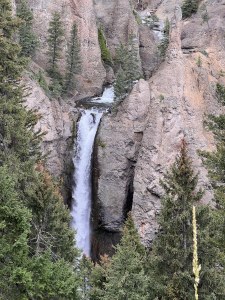
Gibbon Falls is another easy stop along the Yellowstone Grand Loop. It is right off the road and can essentially be viewed as a drive by if you’d like. There is a parking lot where you can stop to get a better picture as well. Gibbon Falls is located on the Gibbon River between Madison Junction and Norris Geyser Basin.
Firehole Canyon Drive
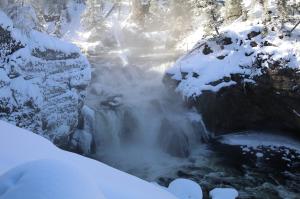
The Firehole Canyon Drive is definitely worthy of a drive through. The one-way drive starts close to Madison Junction and winds on a southerly route for about two miles before popping back out on the Grand Loop Road. Dan and I got to take this loop as part of our Yellowstone snowmobiling tour earlier this year. It was so dramatic seeing it in the snow. Even in summer, the drive is absolutely gorgeous, as you wind down through the canyon of the Firehole River. There are some cascading waterfalls on the river as well. This also used to be one of the two places in the park where you could access a swimming hole. It was closed during COVID and has yet to reopen. I have no idea if there are plans to open it in coming years.
Glacial Valleys
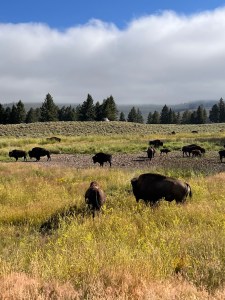
Yellowstone’s massive volcano shaped the land in extensive ways, but it also was shaped by other natural factors. Glaciers used to cover the Yellowstone valley and one of the best places to see evidence of glacial erosion is in Lamar Valley. You can access the road off the Grand Loop Road in Roosevelt. Lamar is an excellent example of glacial erosion because of the massive boulders that were left behind on the valley floor from the receding glaciers. Lamar is most often visited because it is a literal wildlife mecca of the park… a place where you can spot wolves, bison, grizzlies, and pronghorn. If you head that way to take in the biodiversity, take note of the glacial erosion as well! Unfortunately, a large portion of the road taking you through Lamar Valley was wrecked due to the early season flooding in the park and we were unable to truly access the whole valley. They hope to reopen the road by mid-October of 2022! Until then, if you hope to visit, you need to get a day use permit for the road, which will only give you access out to Slough Creek. These you can find on recreation.gov.
Mountain Peaks
Yellowstone is part of the Rockies. Grand Teton National Park sits directly on its southern border. There are mountains all around the park, with many ridges forming the caldera rim. One of the most beautiful drives you can take to experience stunning mountain views is to drive the portion of the Grand Loop Road between Canyon Village and Tower-Roosevelt. Here, you get sweeping views over Dunraven Pass. Lots of pull offs to get great photos. You can also access trailheads to a few trails, including the trail to the summit of Mt. Washburn.

Yellowstone Lake
Yellowstone Lake is another marvel within the park boundaries. The lake is also massive, with 141 miles of shoreline. It is the largest high elevation lake in North America, sitting at over 7,000 feet of elevation. In places, it is more than 400 feet deep. There are many points that you can access the lake. The eastern entrance road skirts the northern part of the lake, and follows it until it intersects with the Grand Loop Road in Fishing Bridge. The Grand Loop road between Fishing Bridge and West Thumb/Grant Village winds along the shores of the lake, with multiple access points and great picnic spots. The West Thumb Geyser Basin skirts the lake’s shoreline, and is an excellent example of how the geothermal features of Yellowstone meld with the natural landscape.

Yellowstone’s boundaries hold so many wonders of the natural world, from geysers and hot springs, to canyons, waterfalls, and lakes. Take your time in the park and try to witness as many as you can.
Thank you for following along with us as we give our tips and tricks to traveling the country, especially with kids. Stay tuned for our next blog post – our top 5 favorite hikes to do with kids.
 Our Pickett Fences