
“The Yosemite, the Yellowstone, the Grand Canyon are properties in which every citizen has a vested interest; they belong as much to the man of Massachusetts, of Michigan, of Florida, as they do to the people of California, of Wyoming, and of Arizona.”
-Stephen Mather – First Director of the National Park Service
Dan and I have been incredibly lucky. It’s crazy to think that we East Coast kids have had the opportunity to visit our nation’s first national park four times together. Yellowstone is the epitome of the American national park. It preserves an area of immense proportion for future generations. It holds a plethora of geothermal features that can’t be seen in such a great concentration anywhere else in the world. Because of the decades of preservation, Yellowstone is able to support a treasure trove of biodiversity within it’s park boundaries and the greater Yellowstone ecosystem.
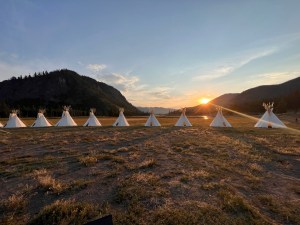
Yellowstone’s sacred grounds were used by a number of Native American tribes for thousands of years before the land became federal property. Twenty-seven tribes have ties to the area, including multiple Sioux tribes, the Nez Perce, the Shoshone, the Arapaho, the Crow, and the Blackfeet. Their history with the park is enough to cover an entire blog post on it’s own. During the last weekend of our stay, Yellowstone began preparations to hold tribal celebrations throughout the park. While we weren’t able to time our visit with presentations by the local tribes, we were able to see some of the preparatory setups, including teepee installations in parts of the park. One of the installations was set up near Madison, where 13 replica teepees stood tall in a valley flanked by mountains on either side. We were able to view the installation at sunset, and it was absolutely stunning.
Yellowstone is our nation’s and world’s first national park, and this year it is celebrating its 150th anniversary. The park was established in 1972 by President Grant, before the National Park Service even existed. This establishment of the nation’s first national park even predates the eventual state boundaries that are mapped throughout the park. As it stands today, Yellowstone lays in parts of Wyoming, Montana, and Idaho. Teddy Roosevelt visited the park in 1903, and his famous quote of “for the benefit and enjoyment of the people” sits atop the Roosevelt Arch at the northern entrance to the park in Gardiner, MT. For the last 150 years, Yellowstone has stood as the paradigm of conservation in the United States, leading the way until the National Park Service was established in 1913, through today.
Yellowstone has so much to offer, and there are so many areas to explore, that it is nearly impossible to contain it all in one blog post. I’ve decided to break down my personal travel guide into a series of blog posts. I don’t know how many there will be in the end, but hope that our travel musings may help someone else as they plan a visit to our nation’s first national park.
Yellowstone is a GIANT Volcano
Yellowstone holds the world’s highest density of geothermal features, and for good reason. The entirety of Yellowstone is a gigantic volcano. During a past visit, when Dan and I got the chance to walk some of the boardwalks with a tour guide, we overheard someone ask “so where is the volcano?” The answer was easy… we were literally standing on it.
The Yellowstone volcano has had three major eruptions in the past 2.1 million years, with the most recent caldera-forming eruption occurring 631,000 years ago. The caldera is incredibly immense, spanning 45 miles wide in some areas. Yellowstone has had more recent eruptions, with lava flows helping to shape the land we see today, but the most recent was about 70,000 years ago. If you are interested in learning more about the volcanic history of Yellowstone, I highly recommend the visitor centers at Old Faithful and Canyon Village. They have beautiful interactive simulations, videos, and graphic representations.
The fact that Yellowstone is a giant volcano is the reason why you can find the density of geothermal features in this part of the US. Once you visit, it quickly becomes easy to see (and smell) just how volatile the landscape really is.
When visiting the national park with kids, we talked a lot about how Yellowstone sits atop a giant volcano, but the easiest way for kids to learn about these features is to see them. Yellowstone holds within its boundaries multiple examples of four types of geothermal features (geo meaning Earth; therm meaning heat). Even my five year old twins were able to quickly learn the names of these four types of features, and could identify them as we walked around the multiple boardwalks in the park.
It can be overwhelming when you first look at a map of Yellowstone when you start see the multiple geyser basins highlighted on the map. There is the Old Faithful Geyser Basin, the Biscuit Basin, the Norris Geyser Basin, West Thumb Geyser Basin… and this is just naming a few. All of them take you to different geothermal features and have miles of boardwalks to traverse.
Which geyser basins are the best to visit? Which hot springs are the best to see? How about geysers? We’ve broken down some of our favorite views below.
My biggest piece of advice is, if you have the opportunity, break up the visitation of these features. On our first trip to Yellowstone in 2013, Dan and I packed all of these multitudes of geothermal features into one day. We lost appreciation for so many of these spectacular sights, so much so that I even cut out visiting Norris Geyser Basin when we brought the kids for the first time in 2019. We visited with them during this trip, and I am so thankful that we did.
So, here are our family’s recommendations for the four types of geothermal features found in Yellowstone:
- Geysers
- Hot Springs
- Mud Pots
- Fumaroles
Before listing off our recommendations for viewing geothermal features, I want to stress the importance of staying on the boardwalks and not straying onto the fragile crust areas that are beyond the boardwalks. These geothermal features are hot, acidic, and each year, result in the injury and sometimes death of people.
Dogs should also remain outside of the park. If you must bring them in because you are driving through the park, consider leashing them to your seatbelts. Remember, dogs are not permitted on any Yellowstone boardwalks or trails.
Geysers are probably the most identifiable geothermal feature found in Yellowstone. Everyone has heard of Old Faithful, and that is the first place most people flock to upon entering the park.
Geysers are one of the four types of geothermal features that can be found in Yellowstone. They occur when a hot spring has a constriction in its plumbing, allowing pressure to build, which eventually causes an eruption. These eruptions should be viewed from a safe distance. Some are predictable, while others are incredibly unpredictable. There are more than 500 geysers in Yellowstone. Here are our opinions of “must-visits.”
Old Faithful
There’s a reason that everyone has heard of Old Faithful and it is the first place people visit. Old Faithful is a predictable geyser, and has been for hundreds of years. It also has a relatively short time between eruptions. Because of this predictability, it can be viewed like the latest feature film, knowing approximately when you can arrive and see it erupt. When a geyser isn’t erupting, it is much less interesting, with just steam coming out of a hole in the ground.

Visitors can log onto the Yellowstone NPS page and see when approximate eruptions will occur for the predictable glaciers. Old Faithful erupts approximately every 74 minutes, give or take 10 minutes. Sometimes it erupts before that 74 minute time and sometimes after. Remember, those eruption times are predictions that park rangers do with a stopwatch. Arrive early and wait. One of the eruptions I observed with the girls this visit was 15 minutes past the predicted time. It was worth the wait though. It was the tallest, most powerful eruption I observed while in the park. Overall, Old Faithful erupts on average 20 times daily.
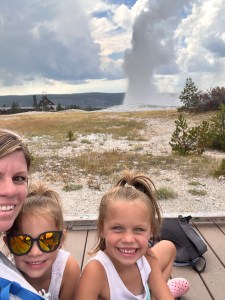
Some interesting Old Faithful facts:
- Old Faithful eruptions can reach 90 to 120 feet in the air.
- Durations can last anywhere from 1.5 minutes to 4.5 minutes, depending on the strength of the eruption.
- Depending on the duration of the eruption, scientists estimate that Old Faithful displaces between 3,700 and 8,400 gallons of water during an eruption.
- That water is hot! Water temperature at the vent during an eruption is around 205 degrees, whereas the steam can reach temperatures of up to 350 degrees!
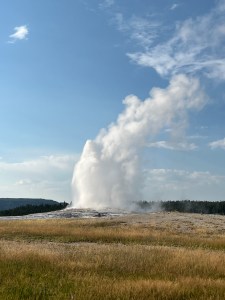
All in all, definitely take the kids to visit Old Faithful. Old Faithful is located in the Upper Geyser Basin. There is a gigantic parking lot, and in the area you can also find a visitor center, a lodge, multiple restaurants and park stores, as well as a gas station. Because Old Faithful is “the” geyser to see, expect to view the natural phenomenon with a few hundred of your closest friends. Find a bench and be respective of others!
If you want to view Old Faithful from a higher vantage point, you can do so by climbing to the Old Faithful Observation Point. It is 0.5 miles up switchbacks, but you can get a different view of the geyser. It can be accessed from the Upper Geyser Basin loop trail. We honestly haven’t hiked this one… not because it was too difficult of a hike, but because we always were able to get great views of the geyser from ground level.
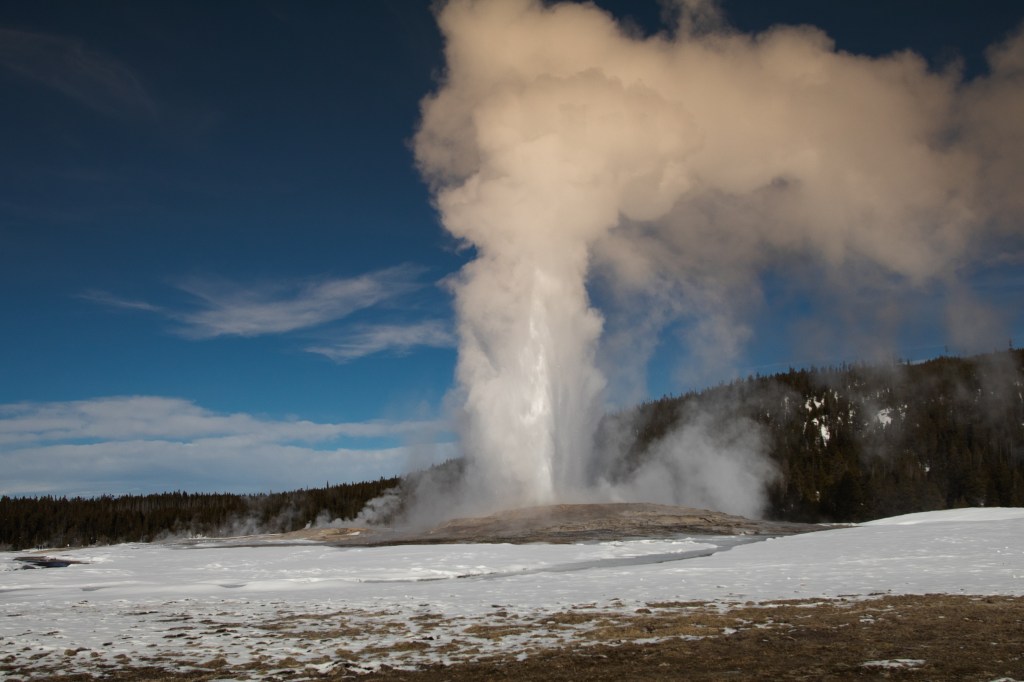
Castle Geyser or Grand Geyser
If you can time it right, you can possibly be in the area to catch an eruption of another geyser in the Upper Geyser Basin. The National Park Service is able to provide predictions on five other geysers, with times posted in both the visitor centers and online at the NPS website. After you’ve watched Old Faithful erupt, you can walk around the geyser ring around Old Faithful to access the Upper Geyser Loop. The Upper Geyser Loop is roughly 3.5 miles, but it can be more or less depending on which geysers you walk to and which boardwalks you take. Both Castle and Grand Geyser are found along these boardwalks.
The boardwalk hike is relatively flat with not a lot of elevation gain. You pass a variety of geothermal features, from geysers, to hot springs and bacterial mats. When you pass any of the predictable geysers, there are benches to use as viewpoints, as well as signage which states the estimated time of eruption, with possible time ranges.
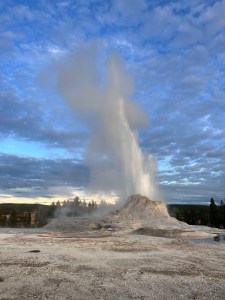
Grand Geyser eruptions are taller than Old Faithful’s! It erupts in bursts that shoot 150 to 200 feet in the air, making it the largest predictable geyser in the world. Eruptions occur every 7 to 15 hours, and predictions are usually made with a 90 minute +/- window. Eruptions can last 9-12 minutes. We, unfortunately, did not get to see Grand Geyser erupt up close. We were within the window, but opted not to wait for the eruption. It was our mistake, because the eruption started about a half hour after we left. Luckily, we were still on the boardwalk and could watch the eruption from afar. We thought about running to catch the tail end, but opted instead to wait for Castle Geyser to erupt. We decided we weren’t going to miss a second one!

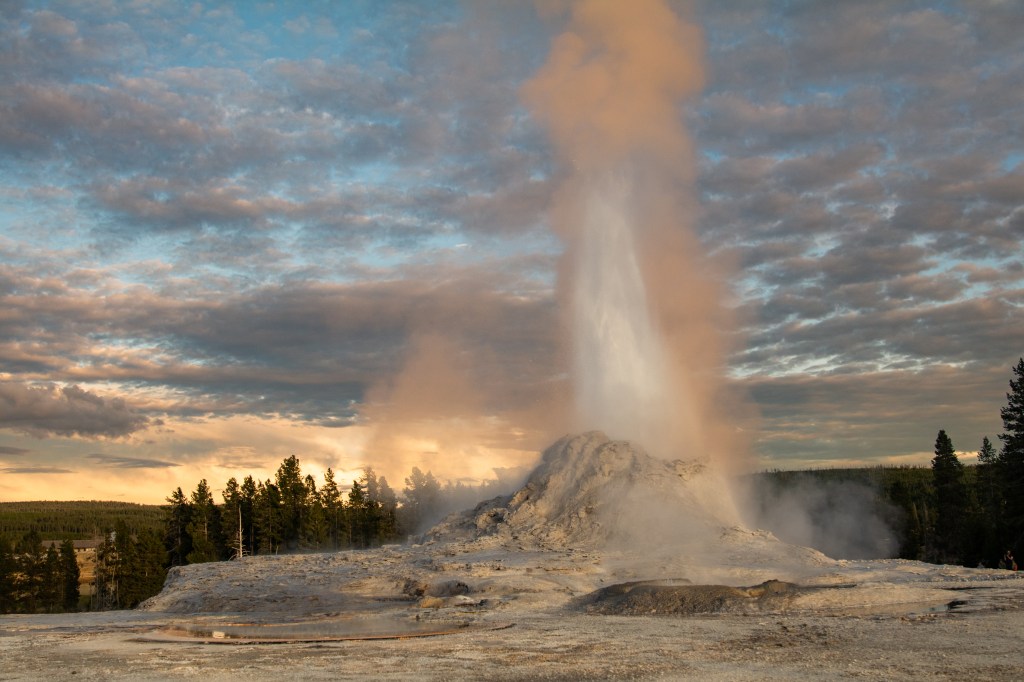
Castle Geyser is also found in the Upper Geyser Basin. The cone of the geyser is what makes it incredibly interesting, as it resembles a castle! Eruptions can reach heights of 75 feet and can last for up to 20 minutes. After missing Grand Geyser, we decided to plop down and wait for Castle to erupt. Prediction times are complete with a +/- 60 minute window. We arrived back to Castle around 7:15 PM, with a predicted eruption time of 7:20. Well, Castle didn’t erupt that evening until 8:15PM, almost 60 minutes later. But, it was spectacular. Dinner was late and the kids were starting to get antsy, but in the end, nothing replaces the memories of seeing Mother Nature in action.

All in all, waiting for geysers can be time consuming… but it can also be awe inspiring. If you are in the park and are spending adequate time to view everything the park has to offer, I definitely recommend catching a second (or third) geyser eruption. In all honesty, this was the first time we have ever waited for an additional geyser to erupt, but in the end, it was well worth it.
Honorable Mentions: Steamboat Geyser and Porkchop Geyser
Both Steamboat Geyser and Porkchop geyser are located in Norris Geyser Basin. They are both on here for different reasons, and if you have the opportunity to walk the boardwalks at Norris, there is a different story to both of the geysers. Both Steamboat and Porkchop are on the Back Basin trail at Norris Geyser Basin.
For how predictable Old Faithful is, you can name Steamboat geyser Mr. Unpredictable. The geyser has periods of sporadic eruptions, and it is highly unlikely that you’ll find yourself in the right place at the right time when the geyser does erupt. The geyser was actually dormant during the early 1900’s, but began a period of activity in the 1960s. In 2018, the geyser began a period of frequent eruptions, with 155 eruptions occurring between March 2018 to now. The most recent eruption (at the time of this blog) was on June 20, 2022.

Unfortunately, we didn’t see Steamboat erupt. But it is worth it to even see the cone of the world’s tallest active geyser. When Steamboat erupts, it can reach heights of over 300 feet and displaces an estimated 70,000 gallons of water! Major eruptions can even cause nearby Cistern Spring to drain completely of water!
Porkchop geyser is also located in Norris geyser basin. I put it in this blog because my kids thought the story behind it was incredibly cool. The geyser was once a hot spring that occasionally erupted. In 1985, the spout started erupting continuously as a geyser. It erupted for four years straight, until it literally blew it’s top in 1989. In September of that year, porkchop literally exploded. Can you imagine being someone who was there to witness that? What you see today is the remnants of the explosion, where parts of the vent are strewn about all over the ground. Today, Porkchop is just a rolling hot spring, but definitely has a cool backstory and is evidence of the immense pressure that can build up in these geysers!
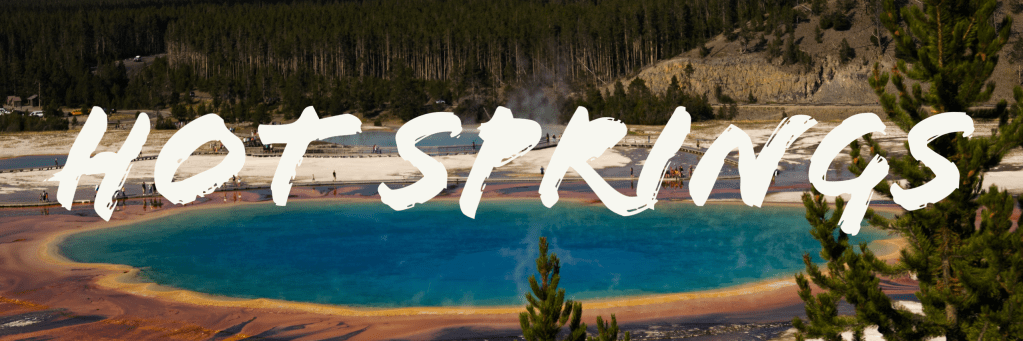
Hot springs are everywhere in Yellowstone, and while some of them can look incredibly inviting, like cool Caribbean waters, the vast majority are extremely acidic, hot, and dangerous! As with geysers, stay on the boardwalks, and don’t step off trail onto the fragile crust.
Hot springs are formed when hot water below the surface has the ability to float freely to the surface. They can be brilliant colors; attributed to either minerals within the pool, heat-loving bacteria, or refractions from the sun. The colors found in each hot spring are what makes each one unique.
Levi and I started reading up on the different types of microbes in the water that can affect the colors of the hot spring. These microbes, known as thermophiles, are heat-loving organisms that thrive at different temperatures in the water. Some of these are bacteria, that thrive in extremely high heat. Some of the pools even have types of algae growing in the hot water. We learned through the kids’ junior ranger program that the hottest thermophiles are in the blue color range, followed by yellow, red, brown, and green is the coolest.
You can observe these thermophiles not only in the pools themselves, but also in the bacterial mats that surround many of the pools and geysers. These bacterial mats are excellent examples of how different bacteria thrive in different temperatures. They create a unique landscape in Yellowstone. These mats are extremely fragile, so it is important to leave them undisturbed. Watch your clothing items as well. I can’t tell you how many different times we saw hats or camera lens covers or other items that had blown or fallen into the bacterial mats.
Grand Prismatic Spring
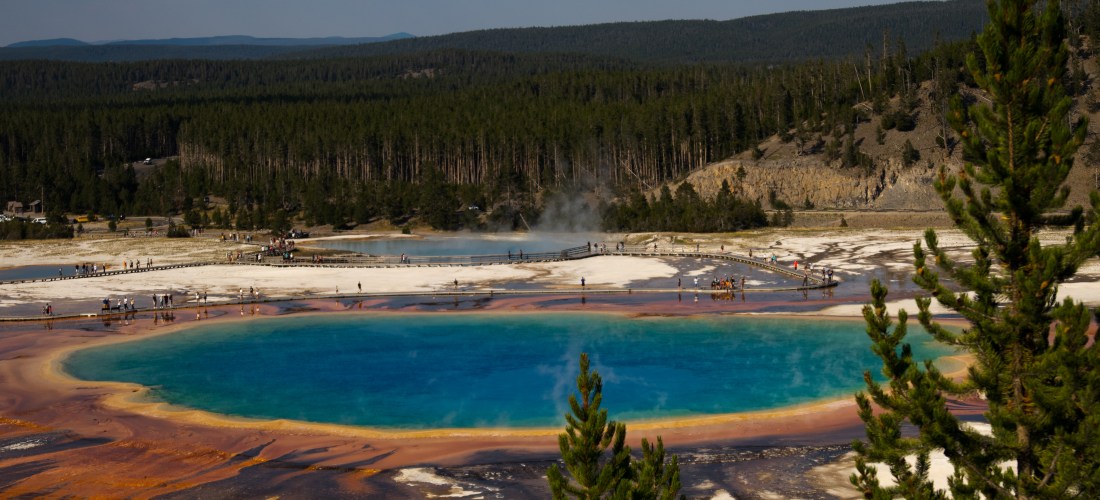
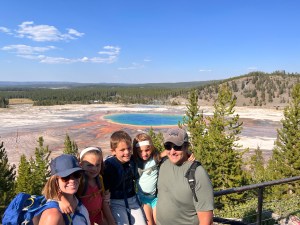
Grand Prismatic literally the pièce de résistance when it comes to Yellowstone, and for good reason. It is huge, and absolutely gorgeous. It is as large as a football field and is nearly 370 feet in diameter. The thermophiles in the water give the spring its brilliant color variations. Bright blue in the middle, with orange, yellow, and green rings around the edges of the spring.
Grand Prismatic is located in the Midway Geyser Basin. There is a boardwalk for visitors to walk on to view the spring close up. But in all honesty, you really cannot fathom the true beauty until you are able to view it from further above. Luckily, there is a way to do just that! Just beyond the parking lot to the geyser basin, there is another parking lot (with an additional overflow parking lot) for the Fairy Falls hike. If you begin this hike, the first portion of the hike will lead you to a Grand Prismatic overlook, which gives phenomenal views of the spring.
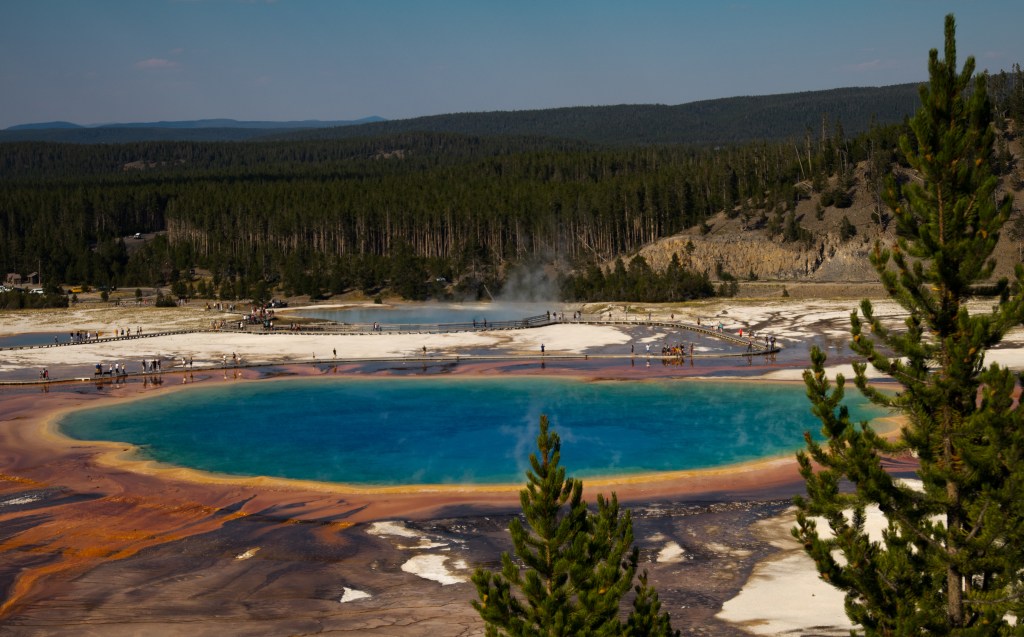
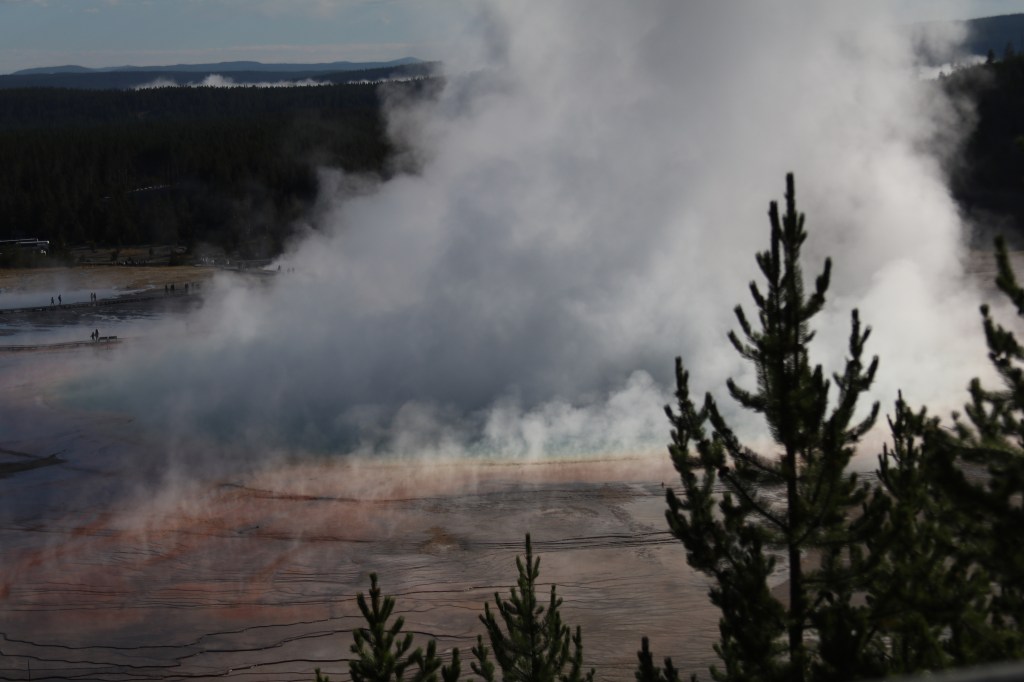
Both the Midway Geyser Basin boardwalks and the Fairy Falls/Grand Prismatic overlook trail are extremely popular destinations to park goers. There will be crowds, especially in the middle of the day. To see just this, I would not recommend arriving early, as I typically would to beat the crowds for a hike. Cooler overnight temperatures cause a large amount of steam in the early mornings, and it is hard to see the true beauty of Grand Prismatic. We made this mistake when we visited back in 2019. We could barely see the spring when arriving at the overlook around 8:00AM. There was a little better view on our walk back after hiking to Fairy Falls. During this visit, we actually went on the hike later in the evening, and it was the best. We arrived at the trailhead around 6:00PM, and while there were still crowds, it wasn’t nearly as busy as the middle of the day and you could see the entire spring very clearly.
Mammoth Hot Springs
The hot springs at Mammoth are completely different than the hot springs in other areas of the park. You can access them right in town, and walk the boardwalks up to the springs. What makes the hot springs in Mammoth different from other parts of the park is the presence of different minerals in the water. Created over thousands of years, calcium carbonate in the water cools as it leaves the hot spring and has created beautiful travertine terraces.

There are two terrace boardwalks located in Mammoth, the upper and the lower. There are over 50 hot springs in the area. While some of them are more majestic than the others, I won’t single any one out because the entire hot spring area is awe-inspiring. You can walk just a portion of the boardwalks, or traverse the entirety of the 3.5 miles.
Honorable Mention: Morning Glory Pool
Morning Glory Pool is located in the Upper Geyser Basin and can be accessed from the Upper Geyser Basin boardwalks around Old Faithful. You can also access Morning Glory from a trail in Biscuit Basin. Either way, Morning Glory is a worthwhile stop. It is sadly a perfect example of what can happen if we do not take care of these geological wonders.
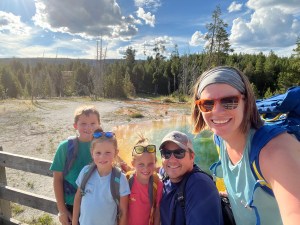
Morning Glory was once much more lustrous. It was named in the 1880s due to its similarity to the beautiful flower. Over the years, vandalism caused the bright blue pool to lose much of its original color. Visitors threw trash, coins, rocks, and logs into the pool. These items clogged the vent, which lowered water circulation and caused the temperature of the water to drop. While vandalism has decreased, especially after the park service relocated the park road making it harder to access the pool, the damage has been done. Unfortunately, vandalism does still occur and the vent still gets pumped on a yearly basis.
Morning Glory is worth the walk still! It is a beautiful yellow color which fades to green.

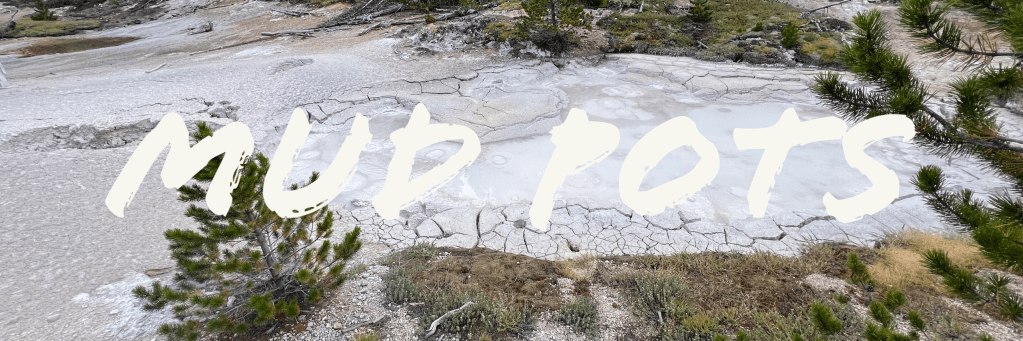
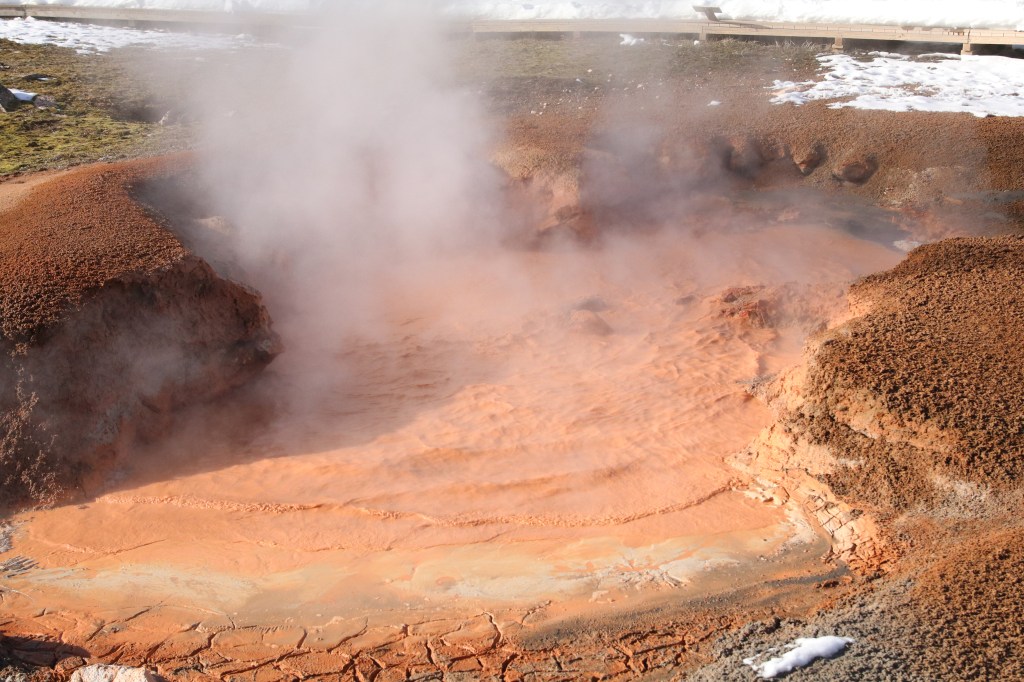
Mud pots are my kids’ absolute favorite type of geothermal feature. It’s probably because of the noises they make as gasses bubble to the surface. Mud pots are the third type of geothermal feature that can be found in Yellowstone. The most interesting part is that they can look different each time you see them. Mud pots are affected by the rain and snow fall and the temperatures outside.
Mud pots are formed when acidic water from under the Earth dissolves rock into mud and clay. Gas bubbles up from below the surface, giving the pots a particularly potent rotten egg smell. Mud pots can also change throughout the year, based on the precipitation, as stated before. Throughout the year, mud pots can have lots of water and be more of a hot spring, they can get drier and bubble like a mud pot, and if they completely dry up in years without a lot of precipitation, they can act like a fumarole.
Here are some of our favorite mud pots to explore in Yellowstone.
Artist Paint Pots
Artist Paint Pots are located in the Lower Geyser Basin near Norris. They have their own parking lot. After walking a short trail that is a 1-mile loop. You will come to a geothermal area packed with hot springs, bacterial mats, fumaroles, and you guessed it… mud pots. The area is named for its pastel multicolored mud pots, and the surrounding soil which is multiple shades of orange and red. The geothermal features in the area are surrounded by red mud, which gets its coloration from the sulphuric deposits in the soil.
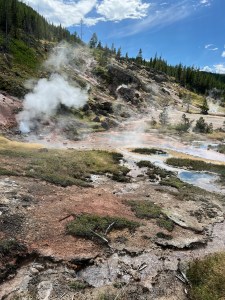

The best mud pots are located at the top of the steps in the loop. As the mud dries in these pools and gets thicker, the gas bubbles push harder to get through, causing mud droplets to fling several feet in the area. Add to that the glooping sound that is made when the mud flies, and the kids will be laughing (and joking that someone smells like a rotten egg).

When we observed the paint pots this past trip, we had rain earlier in the day. As a result, we were able to see the mud pots in two different stages. There was one pot which had a drier texture and thicker mud flinging into the air. Next to that pot, another one had much looser mud, which looked almost as if it was boiling. Artist Paint Pots is definitely worthy of a stop on your Yellowstone geothermal tour.
Mud Volcano
The Mud Volcano in Yellowstone is actually located in an opposite part of the park from the majority of the geyser basins. You can find it just off the Yellowstone Loop Road south of Hayden Valley. There is a short boardwalk trail of just under a mile that you can walk around there, but the mud volcano portion is visible from the parking lot.
The mud volcano was first observed in the 1870’s and shortly after being first discovered and documented, it exploded and coated nearby trees in mud when it came to the surface. It used to have a muddy dome over it, but the explosion left behind a very large crater of bubbling mud. There are multiple hot springs in the area, all filled with boiling mud. They’ve been aptly named cauldrons.

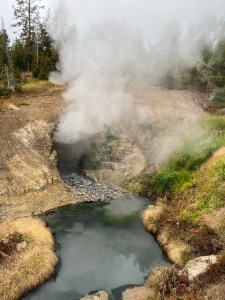
While not a mud pot, another worthwhile stop if you are in the mud volcano area is the Dragon’s Mouth Spring along the same trail. Here, boiling water rolls out of a cave-like opening. Steam billows out of the opening, and water is lapped along the outer shores as the gas bubbles emerge. All the while, strange noises can be heard coming from the mouth of the cave, giving name to it’s namesake of Dragon’s Mouth. Definitely worth a look at this interesting feature in the park!
Honorable Mention: Fountain Paint Pots
Fountain Paint Pots are another good place to observe some mud pots in action. They are located in the Midway Geyser Basin near Grand Prismatic. There is a short boardwalk which takes you past all four types of geothermal features: some geysers, hot springs, mud pots, and fumaroles! The boardwalk is only a little more than a half of a mile and an easy stop!
These mud pots are very similar to the ones described in the paragraphs above. The reason they’re worth visiting is because no two mud pots are the same. Some of the mud pots on the trail I’ve seen at some points nearly devoid of moisture, and spitting out great amounts of mud. This most recent visit, however, we saw one mud pot filled with water that was boiling. It was a much different experience than the other times I have visited!
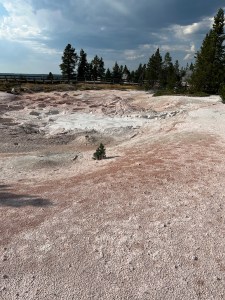
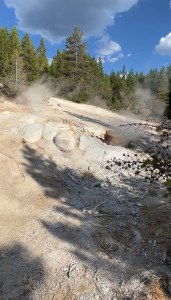
Fumaroles, also known as steam vents, are the final type of geothermal feature that can be found in Yellowstone. While, in our opinion, not nearly as fun to look at as the other types of geothermal features, they still deserve to be highlighted!
Fumaroles are essentially geysers with so little water in them that they never erupt. The little water that is in the vents turns to steam before reaching the surface, sometimes producing a hissing noise by the time it reaches the surface. Interestingly enough, these are the hottest geothermal features in the park, as the steam is hotter than water temperatures in other types.
Roaring Mountain
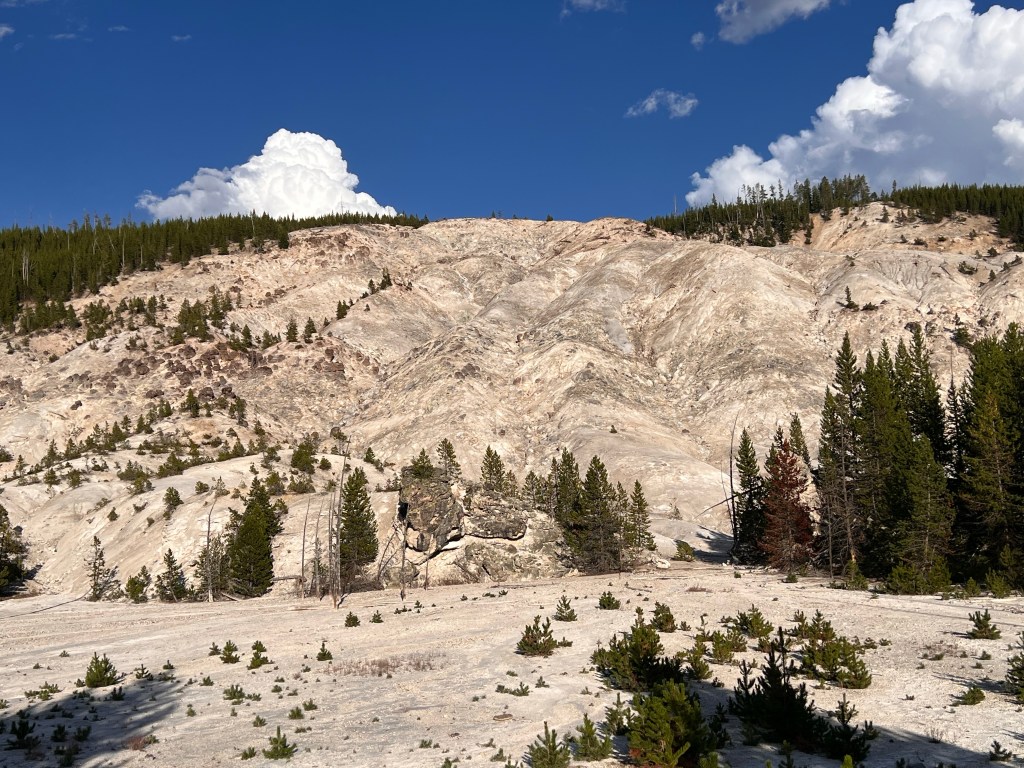
Roaring Mountain is the best place to observe fumaroles in action. Located off the park road, just a few miles north of Norris Geyser Basin, there is a parking lot for you to observe the steam vents from afar. In the late 1800s and early 1900s, the number, size, and power of the vents was much greater than it is today. At the time, it was said that the hissing sound coming from the vents was so loud that the noises could be heard up to five miles away.
While not as spectacular as it once was, we were able to stop and still see a few vents producing steam. You can view them from a safe distance, most likely without even having to get out of your car!
Honorable Mention: Puff and Stuff Geyser
Stuff and Puff geyser is located in Norris Geyser Basin, so you can hit it on the same time as visiting Steamboat Geyser and Porkchop Geyser. You can access it on the Back Basin trail at Norris Geyser Basin. While technically not a steam vent because it is still an active geyser, it is highly unpredictable as to when eruptions will occur. The reason I listed it here is because of the connection between geysers and fumaroles. When geysers are building pressure, they are essentially just steam vents producing lots of steam! And Stuff and Puff turned out to be a favorite of our kids because it produced the hissing noise typical of powerful steam vents. We stood and listened to it for some time.
In Conclusion
I know this was a long blog post, but I hope it was able to provide someone with valuable information when visiting Yellowstone. The important thing to remember with kids is that everything you do is a learning experience. Sometimes, the best learning experiences are those that are hands on and in front of them.
By the end of our trip, even my five year old twins could identify each of the geothermal features as we passed them. They could tell me their favorite memories and which geysers and hot springs they liked the most. My eight year old knows the meaning of thermophiles… we even talked about the roots in the word and what the word parts mean. He could identify different temperatures of the hot springs just by looking at the colors of the bacteria living at different temperatures.
Most importantly, have fun with it! But be safe at the same time. Yellowstone is a place unlike any other in the world. And it’s here… in our United States. If you haven’t had a chance to visit it yet… book the trip! Do it! See the United States! And follow along with us, as we give tips and tricks to touring the United States with our kids.
What will the next blog post be in our Yellowstone series be? Stay tuned!
 Our Pickett Fences